
How to Choose the Best Steel Mill Equipment?
Choosing the right Steel Mill Equipment is not a catalog exercise. It is a decision about product quality, operating conditions, maintenance capacity, and the mill’s next production goals. A rolling line that handles thick plate has different needs from a wire rod mill. Details matter: furnace temperature consistency, roll-change time, cooling-water flow, and the space available for maintenance.
A useful cost-minded reminder, often attributed to steel industry pioneer Andrew Carnegie, is: “Watch the costs, and the profits will take care of themselves.” For equipment buyers, that means looking beyond the purchase price. Compare expected energy use, spare-parts availability, service response, and the cost of planned downtime. Ask vendors for performance data from installations with similar products and operating schedules. A polished brochure is not enough.
This guide explains how to assess capacity, process compatibility, automation, safety features, and supplier support. It also highlights questions to ask before signing a specification or acceptance plan. Bring actual production data to supplier discussions, including product dimensions, shift patterns, and recurring bottlenecks. Even careful comparisons have limits. Forecasts can miss real-world wear, and a low-cost component may become expensive if it is difficult to maintain. A practical choice balances measurable performance with the mill team’s experience. At times, the best answer may be less obvious than the spreadsheet suggests.
Define Production Goals and Required Steel Grades
How to Choose the Best Steel Mill Equipment?
Define Production Goals and Required Steel Grades
Set annual output, product mix, target dimensions, tolerances, and planned operating hours. A line built for commodity rebar may not suit thin, high-strength sheet. Still, forecasts are rarely perfect. Allow for maintenance downtime and a realistic production ramp-up. The World Steel Association’s 2024 Statistical Yearbook reports 1,892.2 million tonnes of crude steel production in 2023. That global figure is context, not a mill-size target; regional demand and confirmed orders should guide capacity.
Define each grade by chemistry and performance requirements. Low-carbon sheet, high-strength low-alloy plate, stainless steel, and electrical steel place different demands on melting, refining, casting, and rolling. Alloy control, cleanliness, slab thickness, and finishing temperature affect strength and surface quality. The IEA’s 2020 Iron and Steel Technology Roadmap estimates that the steel sector causes about 7% of global energy-related CO2 emissions. Compare energy use per tonne alongside yield and quality. Small differences matter. Ask a metallurgist to validate grade ranges against applicable standards and trial data; paper specifications can miss shop-floor variation.
Tips: Build a grade matrix listing chemistry, thickness, width, strength, finish, and annual volume. Mark each grade as core or occasional, then size equipment around the core mix with a realistic allowance for changeovers.

Identify the Steelmaking Processes and Equipment Types Needed
Choosing steel mill equipment begins with the route your plant will use. A blast furnace and basic oxygen furnace line needs burden preparation, coke handling, hot-metal transport, converters, and gas cleaning. An electric arc furnace shop instead depends on scrap or direct-reduced iron handling, charging systems, electrodes, and reliable power supply. The difference matters. A furnace alone cannot define the process.
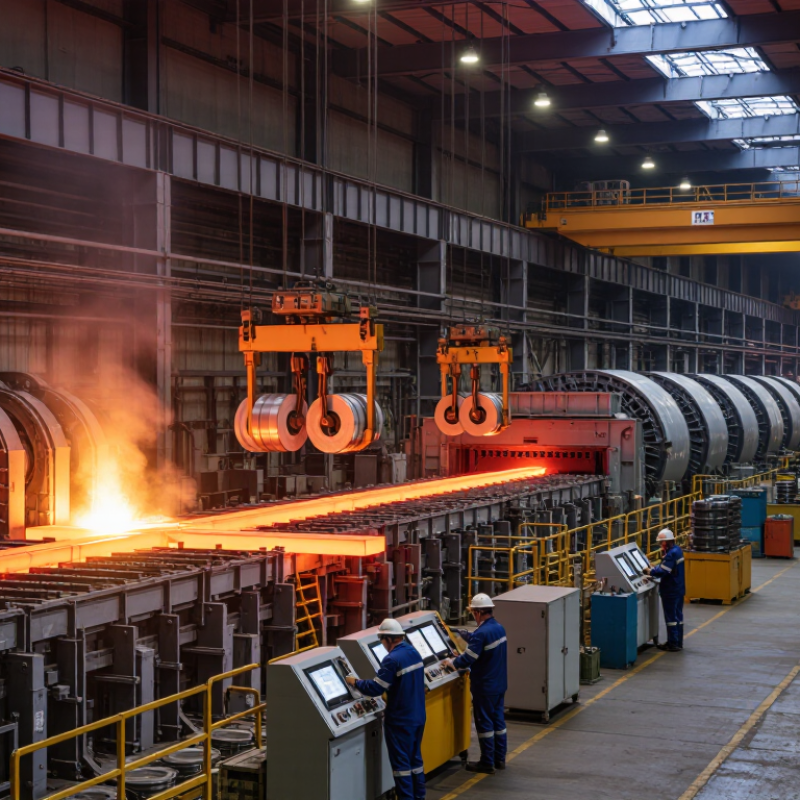
Map each step from raw materials to finished steel. Secondary metallurgy may require ladle furnaces, vacuum treatment, or alloy-feeding systems to meet chemistry and cleanliness targets. Continuous casting equipment must match billet, bloom, or slab production, while rolling mills need to suit the required dimensions and steel grades. Include cranes, conveyors, cooling beds, water treatment, and dust collection in the equipment list. These supporting systems can shape output as much as the main machines.
Check capacity against realistic production schedules, not just peak targets. Review maintenance access, operator skills, energy use, and the space available for foundations and material flow. A narrow aisle or undersized ladle bay can cause recurring delays. It is easy to overlook that. Ask suppliers for process data, utility requirements, and operating references, then verify assumptions with your engineering team. Some estimates will change once actual scrap quality, product mix, and downtime are considered.
How to Choose the Best Steel Mill Equipment?
Identify the steelmaking process and compare its typical emissions intensity before selecting equipment.
Equipment guide: The BF–BOF route typically uses a coke oven, blast furnace and basic oxygen furnace. The natural-gas DRI–EAF route uses a direct-reduction shaft furnace and electric arc furnace. The scrap-EAF route mainly uses an electric arc furnace. All routes may also require secondary metallurgy, continuous casting and rolling equipment.
Values are indicative tonnes of CO₂ per tonne of crude steel; actual intensity varies with plant configuration, fuel and electricity mix, raw materials and reporting boundaries.
Compare Capacity, Technical Specifications, and Compatibility
Choosing steel mill equipment starts with the mill’s real production target, not its maximum catalog rating. Compare required tonnes per hour with sustained output across normal shifts. A line rated for 20 tonnes per hour may deliver less when billet size, alloy, or changeovers vary. Measure the real load. Review peak demand too, but avoid paying for capacity that sits idle.
Technical specifications should match the material and process. Check working temperature, motor power, roll or furnace dimensions, tolerances, cooling demand, and maintenance intervals. Ask how output changes across grades and sizes; one headline figure rarely explains the full operating range. Request test data or a sample production plan, then verify the assumptions with operators and maintenance staff. Small gaps matter.
Compatibility can decide whether capable equipment works smoothly in an existing mill. Confirm floor space, foundation loads, electrical supply, water flow, extraction connections, and control-system interfaces. Measure access routes and service clearances, not just the equipment footprint. A new unit may meet every stated specification yet slow production if conveyors, cranes, or cooling beds cannot keep pace. This is easy to overlook. Record interface requirements in writing, and flag uncertain measurements before selection. Some details may change during installation; plan for that rather than pretending otherwise.
Evaluate Equipment Quality, Safety, and Maintenance Requirements
How to Choose the Best Steel Mill Equipment?
Steel mill equipment must withstand heat, scale, vibration, and repeated heavy loads. Ask for material certificates, load ratings, and test records for the exact machine configuration. Do not rely on a polished brochure. Inspect welds, guards, emergency stops, and access points during a site acceptance test. Small gaps matter. A glove can catch where a drawing shows clear space. Check that safety devices remain usable during cleaning and roll changes, not only during normal production. The U.S. Bureau of Labor Statistics reported 2.8 recordable injury and illness cases per 100 full-time manufacturing workers in 2023. That sector-wide rate is not a steel-mill benchmark, but it supports regular, task-specific hazard reviews.
Maintenance fit matters as much as purchase price. Review spare-part lead times, lubrication points, inspection intervals, and safe isolation procedures for stored energy. Ask for failure histories from similar heat and dust conditions. The U.S. Department of Energy’s Operations & Maintenance Best Practices guide estimates predictive maintenance can save 8–12% compared with preventive maintenance, and 30–40% compared with reactive maintenance. These are guide estimates, not guaranteed mill results. Start with critical drives, bearings, and hydraulic systems; monitoring every asset may be overkill. That is easy to miss. Poor sensor placement can create noise, not insight. Compare actual downtime logs with planned service windows before specifying condition-monitoring tools.
How to Choose the Best Steel Mill Equipment? — Evaluate Equipment Quality, Safety, and Maintenance Requirements
| Equipment Type | Quality and Performance Checks | Safety Evaluation | Maintenance Requirements | Useful Acceptance Evidence |
|---|---|---|---|---|
| Reheating Furnace | Check temperature uniformity, heating capacity, fuel consumption, burner control, and the condition of refractory lining. Confirm performance against the production range and material specifications. | Review burner-management interlocks, flame-failure protection, fuel shutoff devices, ventilation, access platforms, and safeguards against hot surfaces and furnace pressure hazards. | Inspect burners, valves, refractory, doors, and temperature sensors on a planned schedule. Keep calibration, leak-test, and refractory repair records. | Commissioning results for temperature uniformity and throughput; operating and maintenance manuals; inspection records for safety interlocks. |
| Rolling Mill Stand | Assess roll and bearing condition, frame alignment, stiffness, drive capacity, vibration, and dimensional consistency of the finished product. Verify suitability for the required product sizes and rolling loads. | Check guarding around rolls and couplings, emergency stops, safe threading arrangements, access controls, and procedures for clearing cobbles or jams. | Plan roll changes and inspections; monitor bearings, lubrication, gearboxes, alignment, and drive components. Use vibration and temperature trends where appropriate. | Alignment and no-load test records; trial-run product measurements; documented guard and emergency-stop inspections. |
| Overhead Crane | Confirm rated capacity, duty classification, hoist and travel performance, brake condition, and suitability for the operating environment. Check that the load path and lifting attachments match the intended tasks. | Verify overload protection, upper and lower travel limits, emergency stop, audible or visual warnings, and safe access. Confirm inspection and operator-training arrangements. | Inspect wire ropes or chains, hooks, brakes, wheels, rails, electrical equipment, and limit devices at intervals set by the applicable rules and manufacturer. | Current inspection and load-test documentation where required; capacity markings; maintenance logs; functional test results for brakes and limit devices. |
| Hydraulic System | Check pressure and flow capacity, pump efficiency, cylinder condition, hose and fitting quality, filtration, and leakage. Confirm compatibility of seals and fluid with operating temperature and duty. | Assess pressure-relief protection, hose-failure risks, stored-energy isolation, guarding, and safe procedures for depressurizing before maintenance. | Monitor fluid cleanliness and temperature; inspect hoses, seals, filters, pumps, and cylinders for wear or leakage. Replace fluid and filters according to condition and service guidance. | Pressure and flow test results; fluid-analysis or cleanliness records; documented isolation procedure; hose and filter replacement history. |
| Dust Collection and Exhaust System | Verify airflow and capture performance at the source, duct condition, filter suitability, fan capacity, and pressure-drop monitoring. Confirm the system matches the dust type and process conditions. | Assess exposure controls, access for safe filter servicing, fire and explosion risks where combustible dust may be present, and appropriate isolation or protection measures. | Inspect filters, fans, ducts, hoppers, seals, and monitoring instruments. Track pressure drop and investigate abnormal changes or visible emissions. | Airflow or capture test records; filter and fan maintenance logs; documented hazard assessment and inspection results. |
| Electrical Controls and Drives | Check control-panel condition, drive ratings, component availability, fault diagnostics, and compatibility with the required operating sequence. Confirm that electrical documentation matches the installed system. | Review electrical enclosures, grounding, protective devices, emergency stops, safety circuits, lockout provisions, and compliance with applicable electrical and machinery-safety requirements. | Keep panels clean and dry; inspect connections, cooling systems, protective devices, and backup components. Back up control programs and maintain current electrical drawings. | Electrical inspection and test records; updated schematics; safety-function test results; backup and change-control records. |
Assess Total Lifecycle Costs and Supplier Support
The purchase price of steel mill equipment is only one part of its cost. Compare expected service life, energy use, routine maintenance, and the price of wear parts. Include installation, operator training, and production lost during commissioning. A furnace that uses slightly more power can add substantial expense across years of daily operation. Ask suppliers for maintenance schedules and realistic replacement intervals, not just headline specifications. A low quote may leave essential service work outside the package. That matters. Even a few unplanned stoppages can disrupt delivery schedules.
Supplier support should be assessed with the same care as machine performance. Request written response times, technician availability, and clear warranty terms. Check whether critical components are stocked nearby and how quickly they can be shipped. Ask who trains operators and whether troubleshooting help is available after installation. If possible, speak with existing users about support during an actual breakdown. Small delays add up. Still, lifecycle estimates are never exact; a spreadsheet can miss a difficult installation or changing shift patterns. Leave room in the budget for contingencies, and compare suppliers using the same assumptions.
